
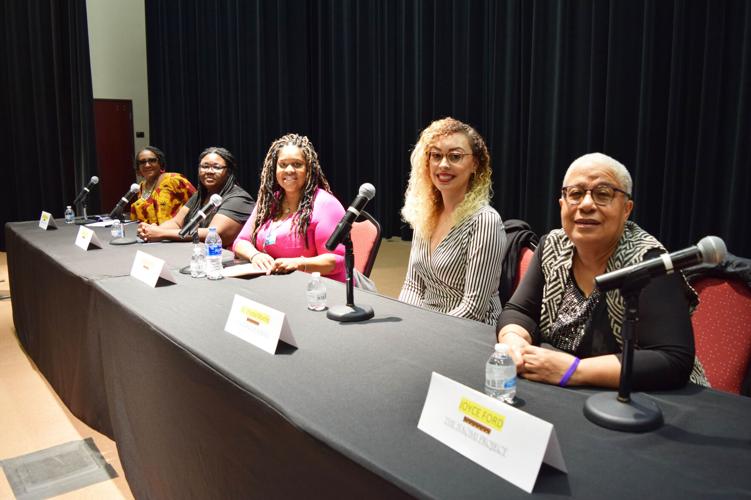
Veyounder Brown, program manager of Lighthouse Ministries, Angela Scott, mental health professional at Pee Dee Mental Health, Nicole Echols, director of external affairs at Hope Health, Crystal Murillo, director of simulation at University of South Carolina and Joyce G. Ford, director of Naomi Project, Inc., participated in the panel discussion.
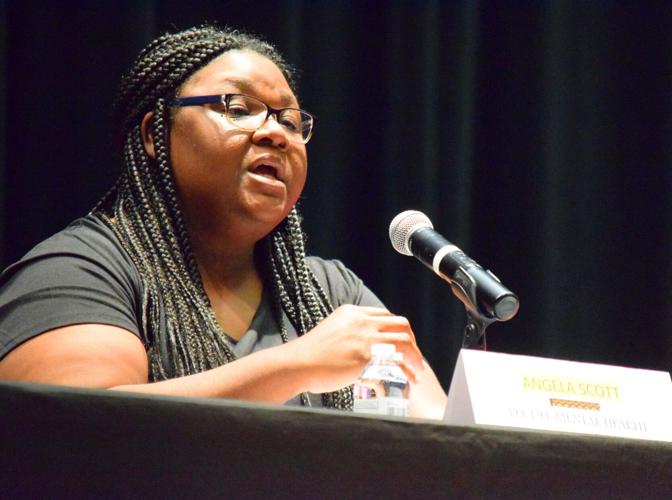
Mental Health Professional at Pee Dee Mental Health Angela Sott passionately speaks at the SIMT audiotorium.

Director of Simulation at University of South Carolina Schol of Nursing Crystal Murillo speaks at Black History Panel.

Letia M. James Student Government Association President moderates the Black History Panel at the SIMT building.
Florence, S.C. — Good mental and physical health is critical for African Americans, panelists at Monday’s Florence-Darlington Technical College Black History Month discussion said.
Florence-Darlington Technical College hosted a Black History Panel on the last day of Black History Month. The panelists were all female and their occupations varied, but connected to black health and wellness.
The panelists were comprised of educators, health-care workers and community partners.
Students and community members gathered in the SIMT auditorium to learn about black health and wellness.
When asked why this panel was important, community activist and Florence-Darlington Technical College alumni Henry Bailey Jr. and Valorie Bailey said, “We are black and need to be well. We are in ministry and it is important for us to not only preach to people, but educate them on how to live a holistic life. Especially as African Americans due to the disparities and disadvantages we face.”
Ruth Silva, a human services student said, “No matter what race you are, it’s important to be aware of the concerns of everyone around you. We need to be aware of different realms of thinking and concerns, so we can understand people.”
The panel discussed the importance of mental health and how the topic is treated as “forbidden fruit” in the African American Community.
“Most people are traumatized by the stigmas of mental health,” said Angela Scott of Pee Dee Mental Health. “The portrayal of mental health issues on the big screen has left African American’s terrified of being perceived as crazy.”
If someone comes up to you expressing concerns of mental health issues, listen to them. That should be our first step in normalizing these types of conversations in our community. This will stop people from suffering in silence and make our community whole.”
Mental health and physical health go hand-in-hand.
If physical health is neglected, it will bleed into mental health. A 2017 article published by Rural Information Hub shows African Americans in rural areas are disproportionately affected by heart disease, cancer, type 2 diabetes, strokes and chronic respiratory disease.
When asked about COVID-19 and the fear within the African American community, Crystal Murillo, director of simulation at University of South Carolina nursing said African Americans did not trust medical professionals.
She recounted times during history like the Tuskegee Syphilis Experiment that contributed to the distrust.
“We need to acknowledge that our community is afraid and that is OK. We have to look at the numbers, more people have died that have not had the vaccine than did have the vaccine.”
The event concluded with the panelist giving tips to the first African American President of Florence Darlington Technical College Jermaine Ford.
Scott said school should partner with Pee Dee Mental health to have resources for students available on campus.
“We do not have connections to any of the colleges. We have access, but we are not making those connections,” she said.
Murillo wanted the president to know that he mattered.
“This is a lot of pressure for a black man. Take care of yourself. Just as much as the community matters and the school and faculty matters. Remember that you matter too Dr. Ford,” she said.
Paula McLaughlin, director of Student Life and Career Development, wanted this panel to bring awareness to health and wellness and how it relates to the rural and urban communities that Florence-Darlington Technical College serves.
“We want to get to know the challenges, advantages, and disadvantages that our students and prospective students face daily to better serve them,” she said.

