
GRAND FORKS — Programs to provide mental health support to students at the University of North Dakota have driven more people to utilize the University Counseling Center’s services, said its associate director of operations.
Carolyn Broden said the decrease in stigma around mental health and therapy and more accessibility to services through telehealth are other factors that have led to an upward trend in clients.
ADVERTISEMENT
“The importance at the university, at the highest level, shows support for mental health and the need for it along with student government also helps us be able to provide a lot of services to students.”
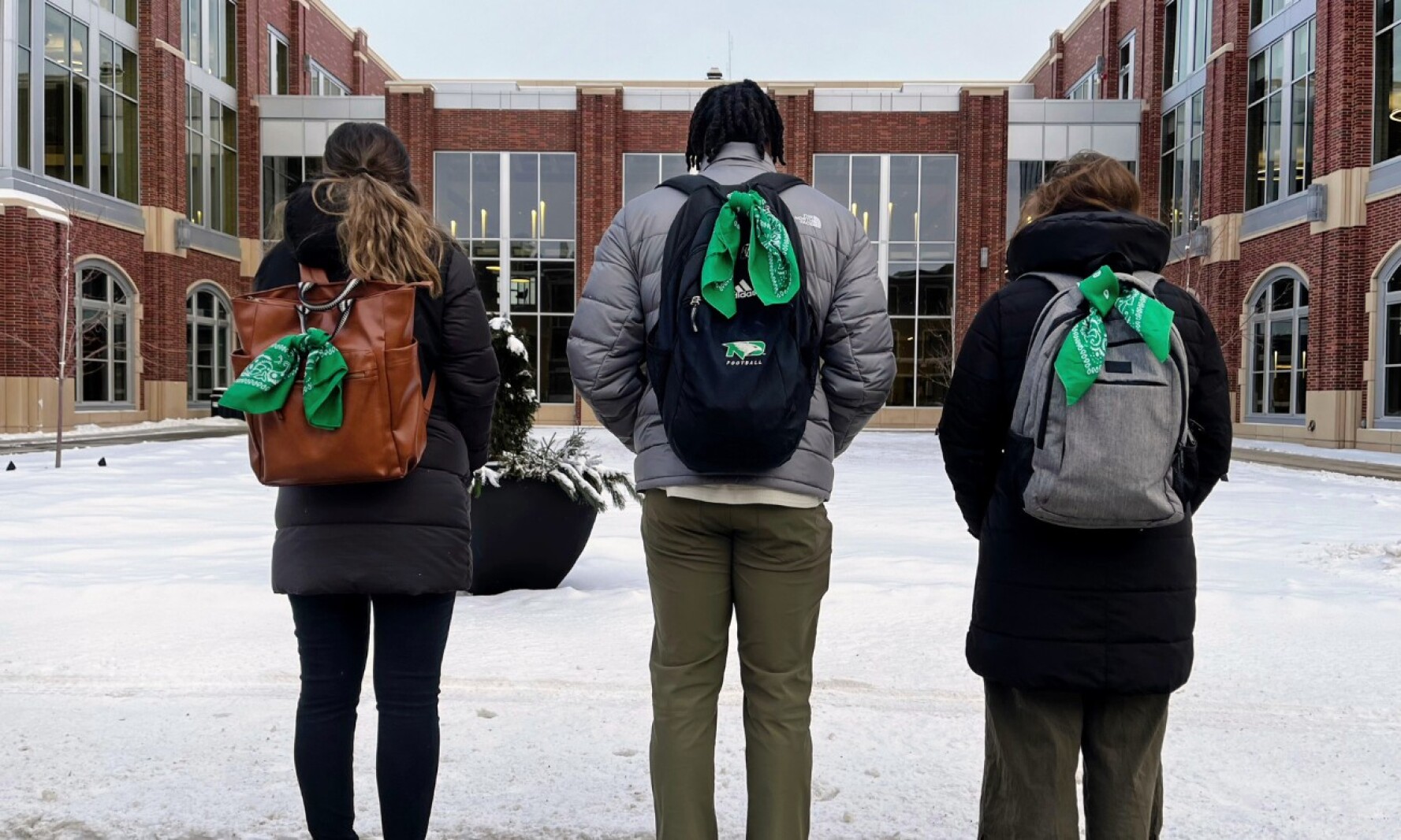
The Green Bandana Project is one of the programs that has raised visibility for the center, which will be holding a training session Saturday, Oct. 4. The program consists of four hours of training students on the Columbia-Suicide Severity Rating Scale (C-SSRS), a list of questions they can ask their peers to see what kind of help they need. Students who go through the training are given green bandanas, often attached to their backpacks, to show other students they can be approached for help.
About 530 students have taken part in the training, Broden said, and the Counseling Center has heard comments from students scheduling appointments that a friend or classmate with a green bandana helped them make the choice to schedule. There have also been instances of a Green Bandana student walking another to the center for help, depending on their level of need. Broden said students don’t need to don the bandana at all times, and if they’re struggling or having a bad day they can take it off. They are not a replacement for therapy, she said.
The Green Bandana Project initially came to UND through the Athletics Department in 2019. The department reached out to the Counseling Center to partner on a bandana program seen at other college campuses following light being shed on mental health issues in the National Collegiate Athletic Association. In order to do it correctly, Broden said the center made sure to get licensed providers involved to do the training.
The Green Bandana Program itself, a mental health awareness and suicide prevention campaign, became a campus-wide idea in fall 2021 after the suicide of commercial aviation student John Hauser. The project really took off in fall 2022, Broden said.
“As a university, it was kind of, ‘what can we do to support our students,’ and this really launched the Green Bandana Project as it is today,” she said.
The program has also expanded to a Green Tag Project tailored for UND professors, faculty and staff. It began in fall 2023, and employees receive bag tags or magnets for their door to show students they have been trained. Almost 300 staff and faculty have taken part so far.
ADVERTISEMENT
There have also been two instances where outside entities asked for training. The Counseling Center has held a training session for law enforcement and medical providers, tailored to fit their jobs.
Student government has played a supporting role in the program for students, backing it and providing funds for food for trainees. When the Counseling Center had last-minute training without the student government’s help, 10 people showed up. The next time, partnering with the student government, there were 68.
“It really shows it’s not just us. Of course we’re doing the training, but when other people are able to use their platforms and their voices to share how important this is, it really goes a long way,” Broden said.
The largest number of trainees the program has received at one time was after Hauser’s death. The training following his suicide was attended by 206 students in one weekend.
“Unfortunately, when a suicide happens, that can prompt people,” Broden said. “People were really affected and really wanted to do something and let people know, ‘I’m here for you, you matter.’”
The UpLift Program, targeted toward aviation students, developed soon after Green Bandana spread across campus. About 60 students have been trained so far in the program, which takes between eight to 12 hours from Broden’s recollection. It focuses more in-depth on aviation’s unique population and is run by the Counseling Center’s aviation psychologist.
Another effort to encourage students to seek mental health help and make the Counseling Center’s services more visible is the Let’s Talk Program. The program was formed in collaboration with housing to bring visibility to the Counseling Center and make it seem less intimidating for people who don’t know about all its resources. Students can ask confidential, basic therapy questions, even if it’s just about the center’s services, take part in activities or play games. The program holds sessions 12-4 p.m. on Tuesdays in the Wilkerson Commons.
ADVERTISEMENT
“Those have pretty good attendance,” she said. “I do know that it has provided more services to students just because they’re made aware of our services.”
The program has had success in getting students through the Counseling Center’s door, Broden said, some mentioning the program when they schedule appointments. The center has 10 licensed providers, including psychologists, licensed clinical counselors, substance use providers and an aviation psychologist. There is also a case manager who also acts as a community liaison, a front desk provider, two full-time doctoral interns and five trainees – either at master or doctoral levels. There are two more psychologists, Broden said, one at the Counseling Center and the other embedded at the medical school.
The center provides individual, group and couples therapy for both mental health and substance use, crisis sessions and psychological evaluations/assessments. The center is paid for in student fees, so accessing services outside of assessments has no additional cost to students, Broden said. Psychological evaluations do have additional costs.
The loss of stigma surrounding mental health over recent years is something Broden credits to getting more students through the door. The center has also been able to do more virtual visits with students outside of campus, which Broden said is another factor in the rise of service use. The Psychology Interjurisdictional Compact (PSCYPACT), an interstate compact, allows the center to provide telehealth services to 43 states. Broden said even students even inside North Dakota and Grand Forks prefer telehealth.
“Accessibility is something we really want to maintain,” Broden said. “We have a lot of distance students who pay student fees, but don’t have access to the Wellness Center, don’t have in-person access to therapy.”

