
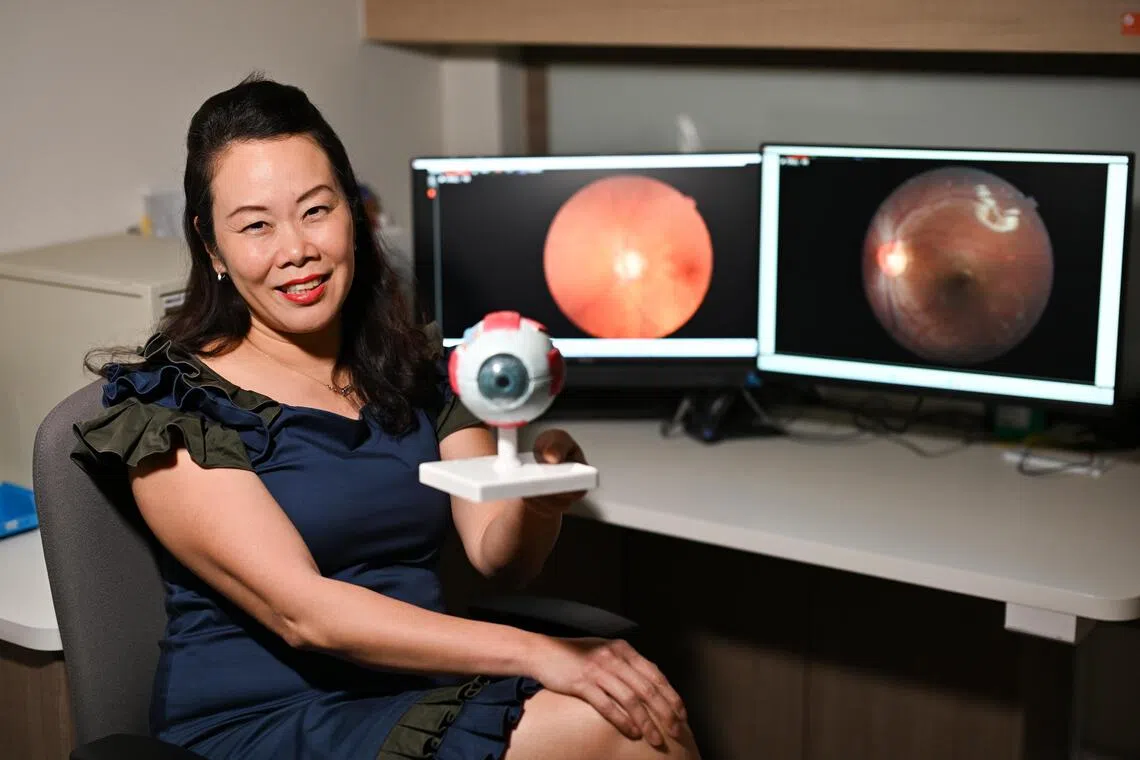
SINGAPORE – At the age of 23, medical student Anna Tan travelled to eye centres in the rural south of the Philippines to service the ophthalmic microscopes used by surgeons during intricate eye procedures.
Along the way, the University of Melbourne student learnt from ophthalmologists there, and discovered more about eye care in regions such as Cebu, Davao and Mindanao.
The trip came about thanks to a scholarship by the Christian Blind Mission, a charity based in Britain that was offering students a chance to learn how to service and clean portable ophthalmic microscopes for cataract surgery.
“Hence, this trip was my inspiration and enabler for me to start my career,” said Clinical Associate Professor Tan, now deputy head of the medical retina department at the Singapore National Eye Centre (SNEC).
It was her first exposure to medical outreach work, she recalled, adding that a survey she conducted on how microscope services could be improved in these regions allowed her to publish her first ophthalmology peer-reviewed publication.
This, in turn, helped her get into the very competitive ophthalmology residency programme at SNEC.
Today, Prof Tan, 45, continues her work in medical outreach as SNEC’s director of global ophthalmology, heading the centre’s Global Eye Health efforts.
In November 2023, SNEC was recognised as a World Health Organisation (WHO) collaborating centre. This sees the centre’s global ophthalmology unit assist the WHO in providing safe and accessible ophthalmic services to the Western Pacific region, which stretches from China to the Pacific Islands, including French Polynesia and the Pitcairn Islands.
As part of its work, SNEC has provided sight-saving services to underserved communities in places such as Laos, Myanmar, Nepal and Fiji.
Over the past two years, 1,500 patients have been screened in remote areas of Laos and Myanmar, while more than 270 sight-restoring cataract operations were performed for those without access to such care in Laos and Nepal.
SNEC also helps in building local capacity via education, training and technology.
Prof Tan said that the centre’s global eye health efforts kicked off in 2021 at the height of the Covid-19 pandemic. As travel was restricted, it conducted webinars on different ophthalmological topics for doctors, in collaboration with major eye hospitals in other countries.
Once pandemic restrictions were eased, its efforts were able to take flight.
The team’s work is largely focused on South-east Asian countries that need the most help.
“In Laos, there are 35 ophthalmologists for about 5.5 million people. They have a similar population to Singapore, but Singapore has about 400 ophthalmologists,” Prof Tan noted.
In March 2025, SNEC signed an agreement with the National Ophthalmology Centre in Laos to set up a school eye-screening programme, among other goals.
On the challenges faced during overseas missions, Prof Tan said the team must overcome language barriers and deal with the occasional delay from administrative red tape.
In March, an office responsible for approving one of SNEC’s projects in Myanmar burned down after a
7.7-magnitude earthquake struck the country
.
And in September, the SNEC team was on a virtual meeting with collaborators in Nepal when “riots just broke out in the background”, Prof Tan said.
The protests led to the resignation of Prime Minister KP Sharma Oli.
The team remains unfazed. Later in October, it will travel to Luang Prabang in Laos, with the aim of screening up to 3,000 people as well as performing some 100 cataract operations, in addition to getting engineers to help repair equipment there.
And in November, the team will travel to the Saptari district in Nepal to conduct screenings, spectacle dispensing and surgery, in addition to collaborating on research projects.
November will also see the publication of a handbook providing information such as dealing with emergency eye health situations, aimed at eye-care professionals across the region.
Capacity building is one of the team’s main goals, Prof Tan said.
“In every country we go to, our idea of success is to be able to leave after three to five years, because they are self-sufficient, and they can take on the roles and responsibilities,” she said.

