
Calling it a “beacon” for LGBTQ+ at-risk youth who may not have a safe place to live or get health care, Detroit officials on Friday officially cut the ribbon on the city’s newest mixed-use affordable housing development which will provide a “safe haven” for those who need it.
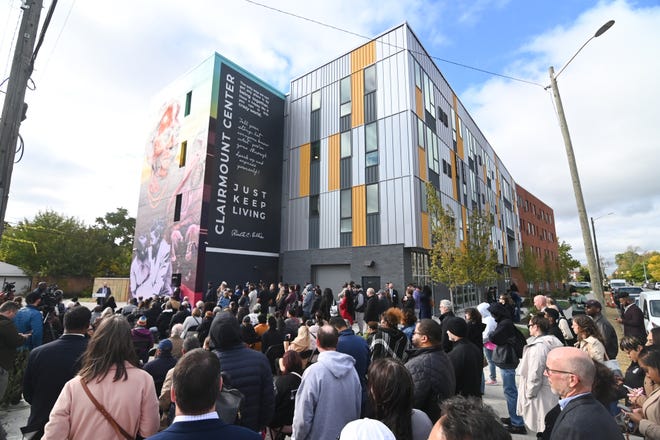
The $16 million Ruth Ellis Clairmount Center, considered one of the first of its kind in the Midwest, features 43 units of long-term, supportive housing along with a health and wellness center at which Henry Ford physicians will provide gender-affirming hormone therapy, sexual health services, HIV care, primary care and mental health treatments. It also includes a cafe, technology center, a fitness center and several community spaces as well.
The 44,000-square-foot center will be “a beacon for LGBTQ+ young people and allies here in the city of Detroit. They will see it as a safe space, they will see it as an action,” said Mark Erwin, co-interim executive director of the Ruth Ellis Center, a non-profit that focusses on helping young LGBTQ+ people experiencing homelessness.
Expenses for 34 of the housing units will be supported by vouchers and eight other apartments will be available for residents earning 30% or less than the area median income.
Detroit Mayor Mike Duggan, U.S. Rep. Rashida Tlaib, City Council President Mary Sheffield and State Senator Adam Hollier joined representatives from the Ruth Ellis Center, Full Circle Communities developers, community residents and other partners, to celebrate the center’s opening with a ribbon-cutting ceremony Friday.
The Clairmount Center is the third affordable housing development to open in Detroit this week, Duggan said.
It is “for the young people in this community, who identify themselves as LGBTQ who are in a situation too often, where they’re not supported at home” he said. “A situation where they are not living in a safe place and they wonder, ‘Does my community care about me? Am I valued? Is there a place for me?'”

The center is named for Ruth Ellis, a Black lesbian who lived with her partner in Detroit for most of the 20th century and was a pioneer advocate for civil rights and LGBTQ+ rights. A four-story mural created by artist Ijania Cortez on the center’s east wall serves as a monument to Ellis.
“My work is about power,” Cortez said. “I do believe that my power is to use my gifts to help people and to just add to the canon of our history and who’s talked about and who’s reverenced. So I hope that this mural does that.”
Funding for the center came from multiple sources, including Detroit, Bank of America, the Michigan Department of Health, the McGregor Foundation, the Kresge Foundation, the National Equity Fund, the Corporation for Supportive Housing and the Federal Home Loan Bank of Atlanta.

The Michigan State Housing and Development Authority gave the center $1.5 million in low-income housing tax credits and provides rental assistance for 34 housing units. Tlaib secured $1 million in federal community project funding and Hollier helped allocate $1 million in state funding to support the project.
Hollier grew up across the street from the new Ruth Ellis Clairmount Center and said the project was personal for him.
“I remember when this space was cleared out and… there was always the expectation that when something goes down, nothing ever is going to come back up,” he said. “To see this project be an opportunity for people to move into the neighborhood and to be a part of this community is an incredible opportunity.”
The center is sorely needed as LGBTQ+ youth are 120% more likely to experience homelessness, Sheffield said. LGBTQ+ youth are also more likely to experience violence, according to the CDC.
“We care about our youth, that we care about our most vulnerable in our community, and this will serve as a safe haven for our young people,” she said. “What I love about this is this is truly permanent supportive housing. It provides wraparound services to address all the needs of our young people.”
hmackay@detroitnews.com
@hmackayDN

