
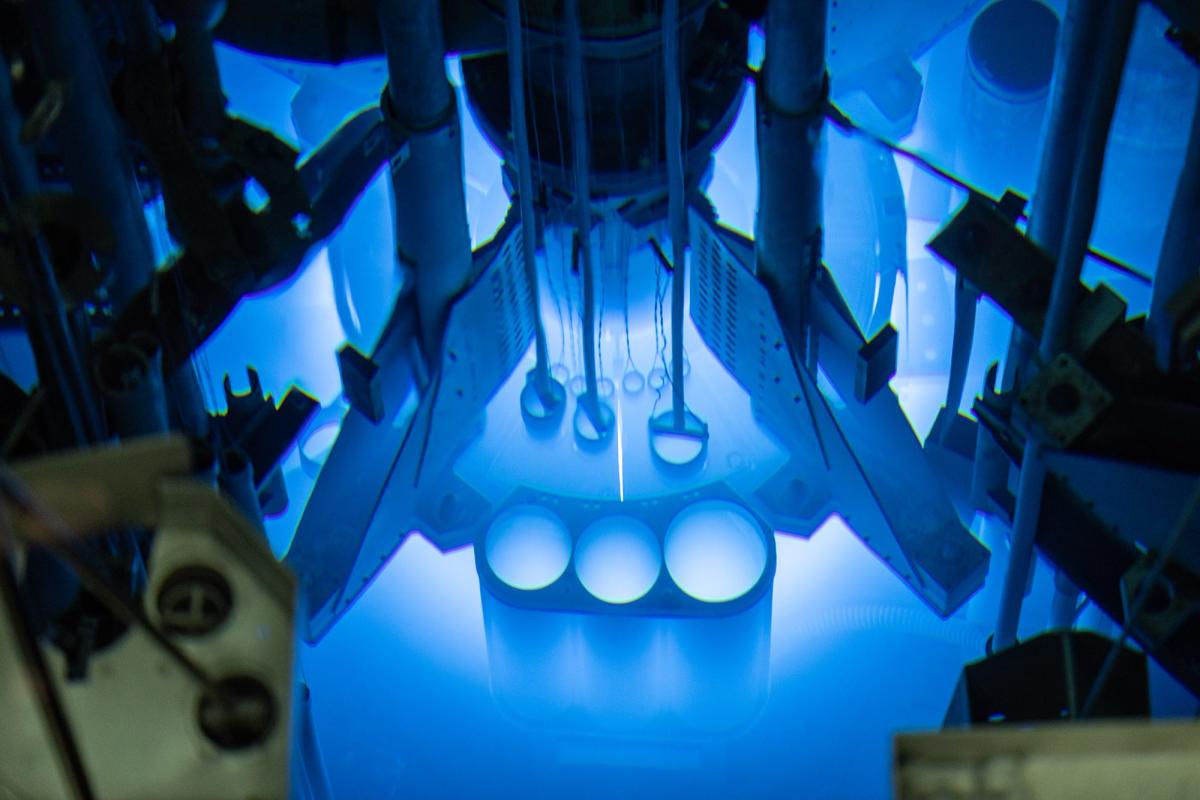
A radioisotope produced at the University of Missouri Research Reactor is being used to treat prostate cancer patients at MU Health Care.
The research reactor this month started commercial shipments to Novartis, where the company uses lutetium-177 produced at the reactor in Pluvicto, the company’s brand name for the radiopharmeceutical.
The shipments mark the start of a multiyear supply agreement between MURR and Novartis.
“The NCA Lu-177 deliveries highlight the reason our researchers and staff work hard every day,” said Matt Sanford, executive director at MURR. “From initial research and development to production, quality assurance and shipping – all of our radiopharmaceutical efforts are focused on the ultimate goal of treating patients and improving lives.”
It has come full circle to benefit patients with advanced metastatic prostate cancer at University of Missouri Health Care.
That MU Health Care is using a therapy produced at MU Research Reactor is interesting on multiple levels, said Gregory Biedermann, MU Health Care oncologist.
“We have the production facility right here in Columbia,” he said.
It needs to go through the manufacturer before returning to MU, but it has to be a quick process, because the effectiveness of the radioisotope degrades rapidly. Biedermann compared it to delivering ice cream before it melts.
“It’s designed for patients who have already progressed beyond chemotherapy,” Biedermann said.
No other treament has worked for the patients, he said.
It’s possible that with further research and testing the radioisotope may get approval for use earlier in treatment, before chemotherapy, he said.
“It does help in survival and quality of life,” Biedermann said.
The drug is administered in six injections, six weeks apart.
Side effects can include liver disease and a decrease in kidney function, Biedermann said.
“The patient has to be closely monitored for fatigue, nasuea and decreased appetite,” he said.
Still, the side effects are much less severe than with traditional radiation therapy or chemotherapy, he said.
A $20 million, three-story addition to the MU Research Reactor is scheduled to open next year. It opened originally in 1966.
A new, state-of-the-art NextGen MURR is planned for the future. It’s potentially 8 to 10 years from opening.
The MU Research Reactor makes MU a leader in this innovative cancer treatment, Biedermann said.
Roger McKinney is the Tribune’s education reporter. You can reach him at rmckinney@columbiatribune.com or 573-815-1719. He on X at @rmckinney9.
This article originally appeared on Columbia Daily Tribune: MU Research Reactor radioisotope reaches patients at MU Health Care

